LKA: Large-kernel Attention for Efficient and Robust Brain Lesion Segmentation
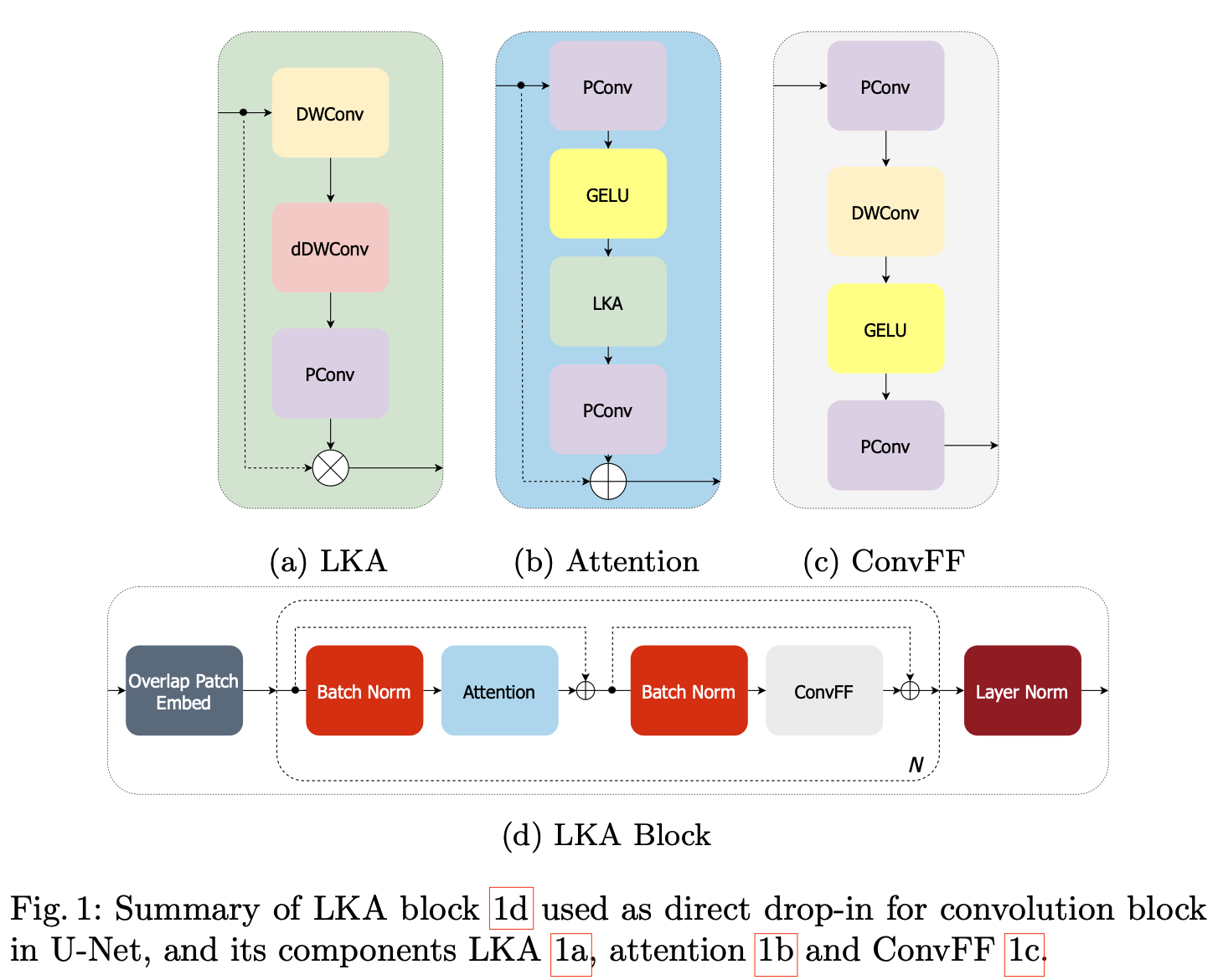
Vision transformers are effective deep learning models for vision tasks, including medical image segmentation. However, they lack efficiency and translational invariance, unlike convolutional neural networks (CNNs). To model long-range interactions in 3D brain lesion segmentation, we propose an all-convolutional transformer block variant of the U-Net architecture. We demonstrate that our model provides the greatest compromise in three factors: performance competitive with the state-of-the-art; parameter efficiency of a CNN; and the favourable inductive biases of a transformer.
Cite as
Chalcroft, L.F., et al. (2023). LKA: Large-kernel Attention for Efficient and Robust Brain Lesion Segmentation. In Medical Imaging meets NeurIPS 2023 Workshop.